

Still hedging in a spreadsheet? Even with SAP.
Your ERP runs the business. Your CTRM runs the physical. And the derivatives — the exchange futures that protect all of it, on LME, CME, ICE or CBOT — live in Excel. Pulse is the hedge book those systems don't have: every trade recorded, allocated to the exposure, marked at end of day and reconciled to the broker. Nothing to migrate, nothing to replace.
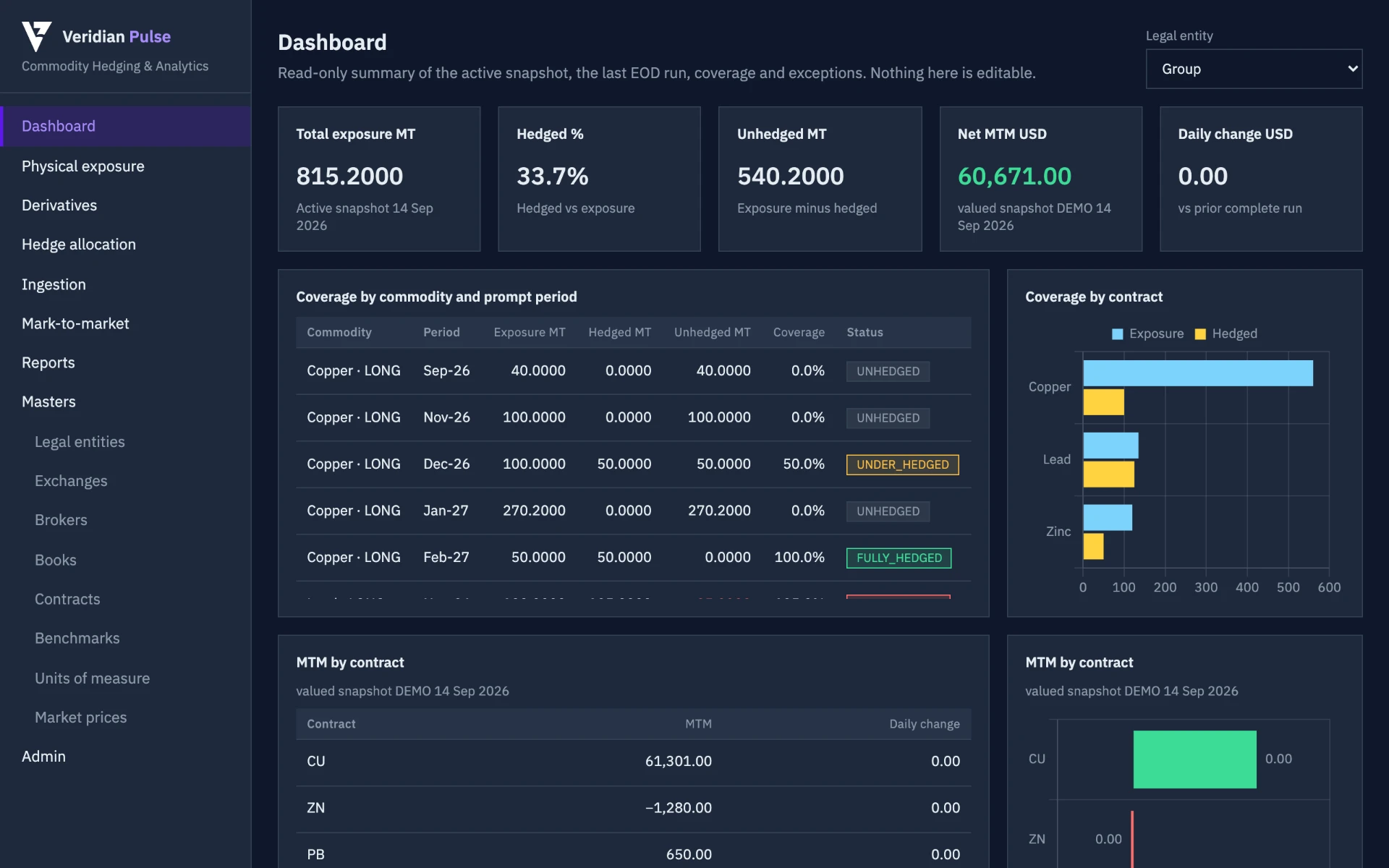
It records what you hedge. It never tells you what to hedge.
Five reasons the hedge book leaves Excel.
Each one is a job a hedging desk does every week by hand, whatever ERP or trading system sits behind it.
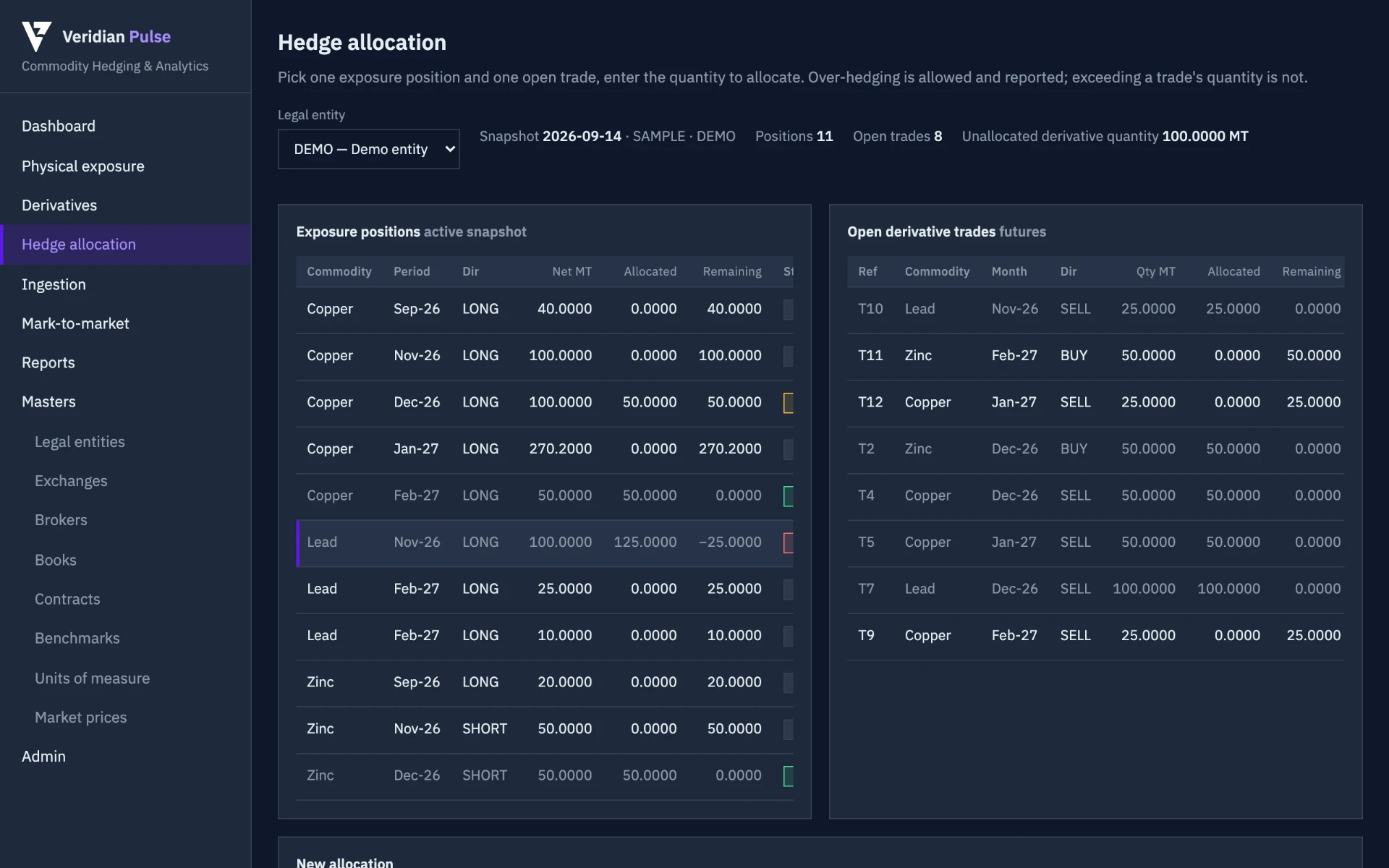
Every exchange hedge, recorded once, allocated to the exposure it covers.
Lots not tonnes, lot size from the contract, prompt date from the exchange. Allocation one-to-one, one-to-many, many-to-one with the rules enforced: a trade can't be allocated past its own quantity, an over-hedged exposure is shown, not hidden. Square-offs, rollovers and deliveries change coverage the moment they're booked. Coverage by contract and prompt month, hedge requirement in whole lots — the spreadsheet you're replacing, done properly.
- Futures on LME, CME, ICE, CBOT, BMD — metals, energy, agri, precious on one contract master
- Lifecycle — square off, roll, deliver — with realised P&L on the trade; allocation invariants enforced
- Coverage and hedge requirement derived, never typed; group and entity views everywhere
| Trade | Side | Lots | Qty | Allocated here | Remaining on trade |
|---|---|---|---|---|---|
| T7 | SELL | 4 | 100.0000 | 100.0000 | 0.0000 |
| T10 | SELL | 1 | 25.0000 | 25.0000 | 0.0000 |
The number the auditor sees is the number the desk saw.
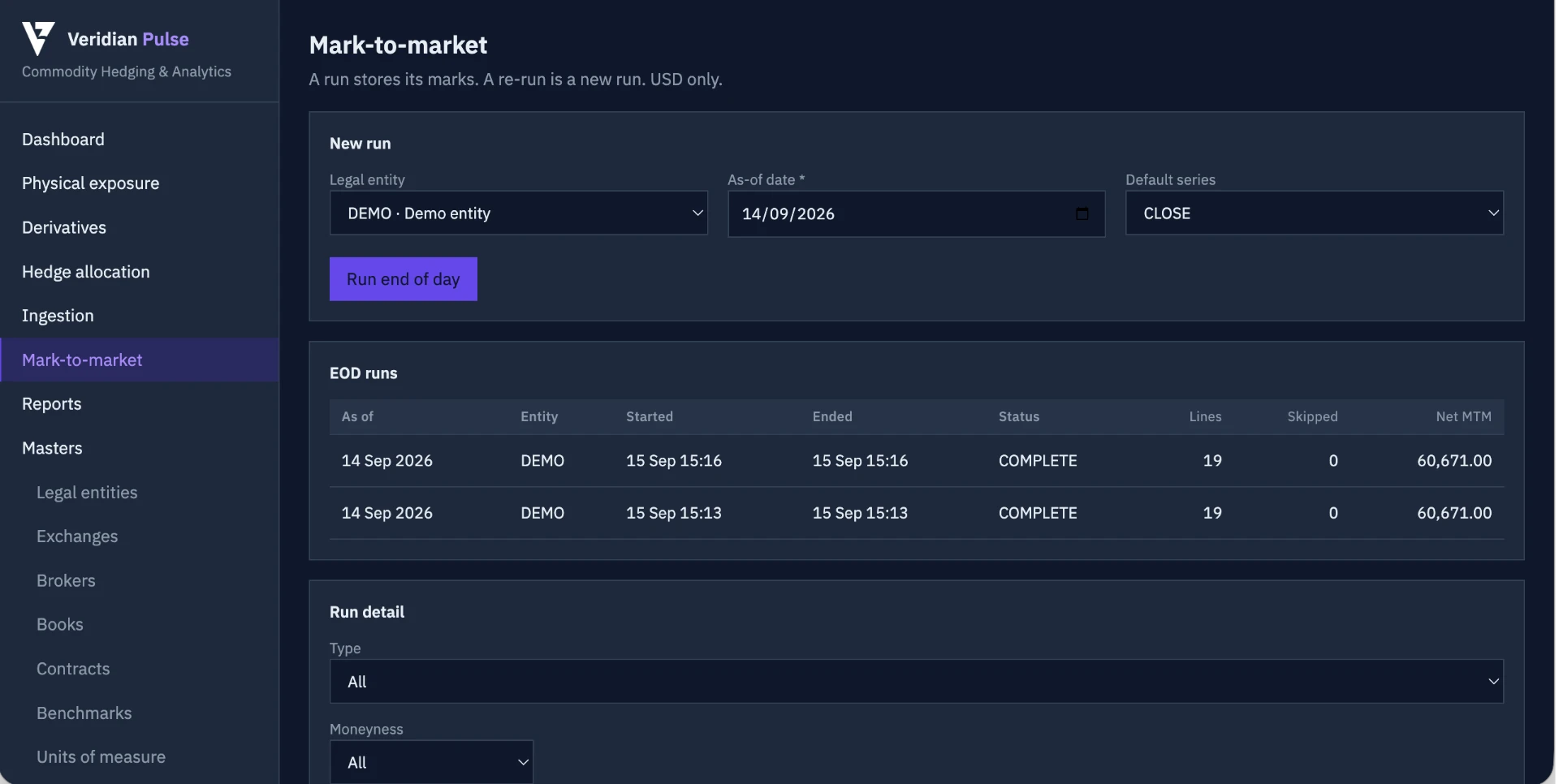
Every end-of-day run stores the marks it used. Physical and derivative legs on one line, signed correctly, netted. Daily change by contract and by book. When the exact prompt has no quote, the line is marked at the nearest earlier tenor and flagged — never silently interpolated. A run from last March still reproduces to the cent.
- Stored marks per run — reproducible, auditable, never overwritten
- Physical and derivative MTM netted on the same line
- Daily change: today's run against yesterday's
| Leg | Basis | Qty | MTM |
|---|---|---|---|
| Physical SHORT, fixed 2,800.00 | (2,750 − 2,800) × 50 × (−1) | 50.0000 | +2,500.00 |
| T2 BUY, struck 2,820.00 | (2,750 − 2,820) × 50 × (+1) | 50.0000 | −3,500.00 |
| Net | −1,000.00 |
The job nobody wants, done before the coffee.
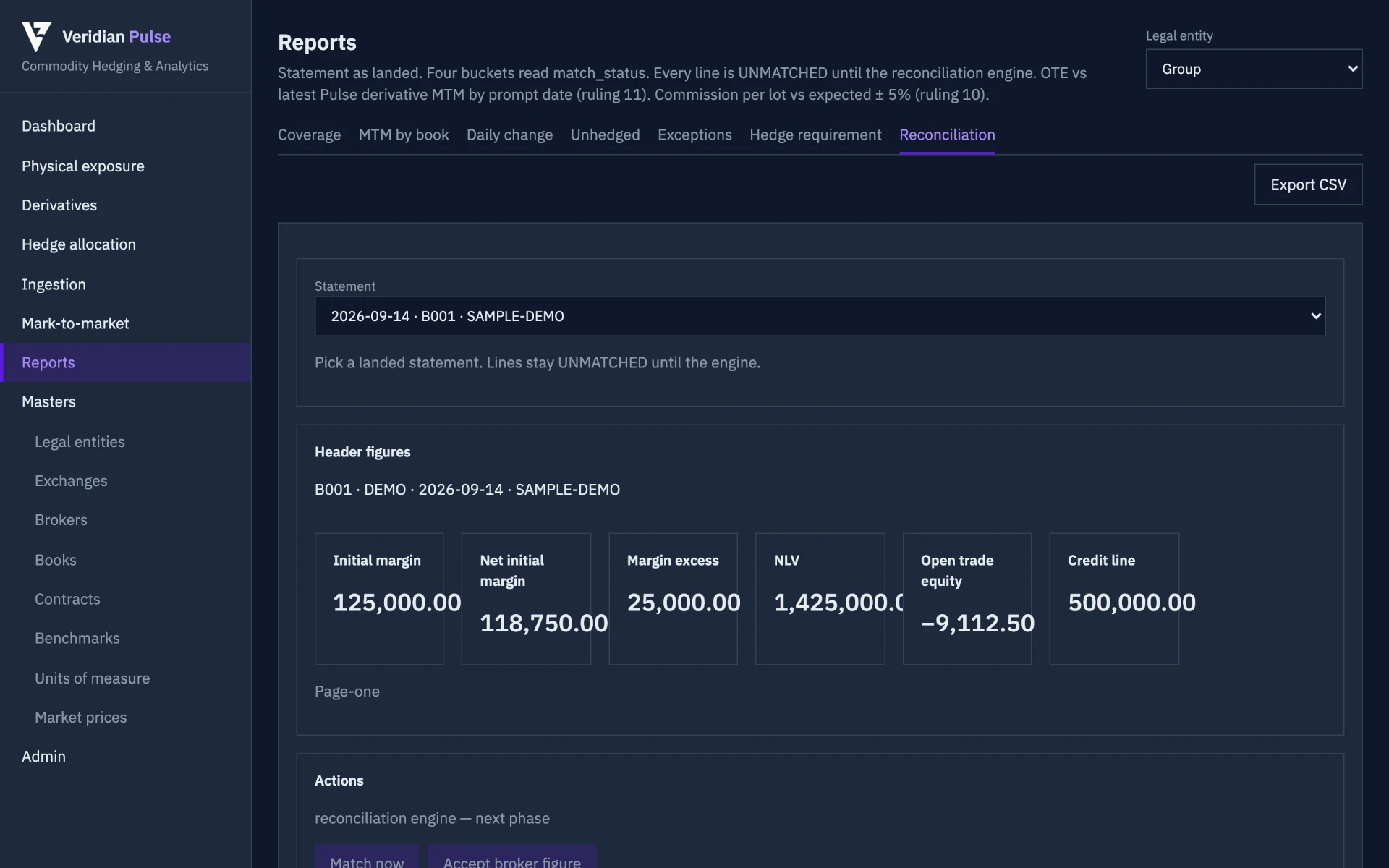
Anyone who has reconciled a broker statement in Excel knows the morning: contract notes against fills, commissions against the agreed rate, open-trade equity against your own mark, and a margin call to fund by noon. Pulse imports the daily statement through a saved template per broker and matches it to the book — into four buckets, with the difference shown, not just a flag. Commission per lot checked against what you agreed. OTE compared to Pulse MTM per prompt date. Margin, NLV and credit line recorded as the broker states them — Pulse doesn't pretend to run the clearing house's margin model.
- Four buckets: matched · matched with differences · on statement not in system · in system not on statement
- Commission per lot vs agreed rate ± 5%; realised P&L reconciled on closed trades
- Statement OTE vs Pulse MTM per prompt — the day-on-day change is tomorrow's margin call
| Prompt date | Statement OTE | Pulse MTM | Difference | Result |
|---|---|---|---|---|
| 2026-12-16 | −6,537.50 | −6,550.00 | 12.50 | > 0.01 — flagged |
An app next to your systems, not a project to replace them.
Your ERP already knows the physical position — net exposure by metal and prompt month. Pulse takes that as a file today and a feed when your IT team is ready, one full snapshot at a time, and never re-keys it. It doesn't originate contracts, doesn't post to your ledger, doesn't want your chart of accounts. That is why it clears procurement where a trading platform would not: nothing to migrate, nothing to rip out, one more app on the estate.
- SAP first, with a documented extract; Oracle, Dynamics 365, custom systems on the same schema
- Runs alongside a CTRM too — the CTRM keeps the physical, Pulse keeps the hedge book
- Twelve legal entities on day one; group and entity views everywhere
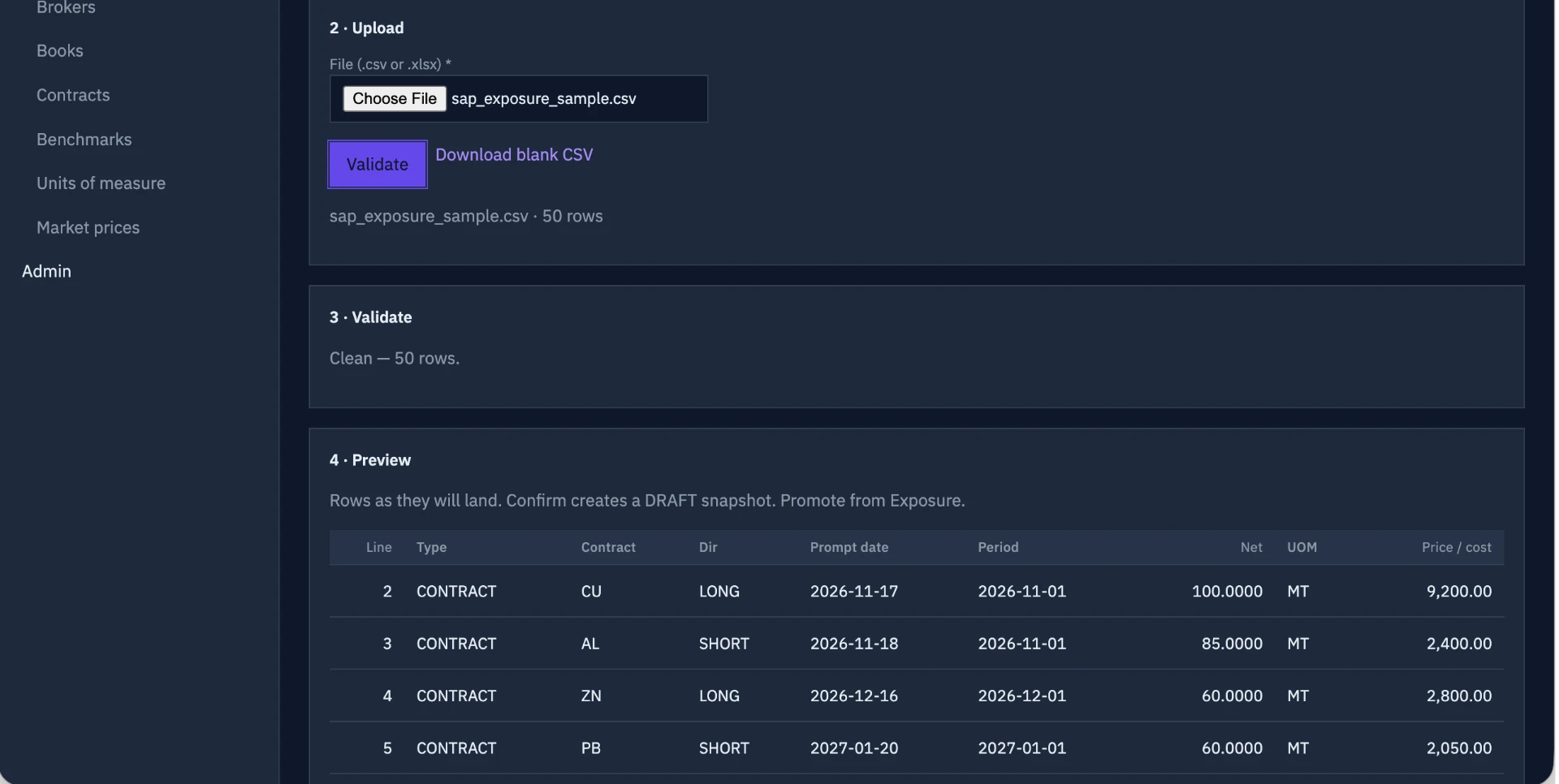
| Contract | Prompt | Direction | Net exposure | Pricing |
|---|---|---|---|---|
| Copper | 2026-11 | LONG | 100.0000 MT | PRICED @ 9,200.00 |
| Zinc | 2026-12 | SHORT | 50.0000 MT | PRICED @ 2,800.00 |
| Lead | 2026-11 | LONG | 100.0000 MT | PRICED @ 2,050.00 |
Your risk analysis, on your numbers — not ours.
Every snapshot and every end-of-day run is an append-only record, so Pulse is a clean feed into your data lake and a CSV export on every screen. The analytics module adds the engines — scenario shocks on the live book, historical simulation on parameters you set and print on the report, and your own variables and formulas run against series you load. Veridian supplies the engine, the loaders and public reference layouts; the data is yours, from your broker, your exchange licence or your own sources. There is no VaR tile under our name; there is your analysis, labelled as yours.
- Scenario shocks: move a curve, see the book
- Historical simulation on your history and your parameters
- Your variables, your formulas, your data — the data lake module
| Item | Value |
|---|---|
| Scenario | Copper −5%, Zinc −3% · book Δ −41,250.00 |
| Lookback | 250 trading days |
| Confidence | 95% |
| Price history | Exchange daily settlements, 1 year — client-loaded |
| Positions | Latest EOD run · Group |
Built for the hedge book. Whatever runs the rest.
Physical exposure
ERP snapshots per legal entity, contracts and inventory, priced quantity and fixed price per line. Promote, supersede, carry forward.
Derivatives
Exchange futures — LME, CME, ICE, CBOT, BMD — with lot arithmetic, full lifecycle — square off, roll, deliver — and realised P&L on the trade.
Hedge allocation
1:1, 1:many, many:1 with the invariants enforced. Coverage, hedge requirement in whole lots, exceptions with a reason.
Mark-to-market
Stored end-of-day runs, physical and derivative legs netted, daily change. Reproducible to the cent, years later.
Ingestion & reconciliation
One import engine for ERP files, trade files and broker statements, with saved templates per source. Four-bucket reconciliation, fee checks, OTE comparison.
Multi-commodity, multi-entity
Metals first — LME base metals in production — with energy, agri and precious contracts on the same masters and the same engine. Twelve legal entities on day one; every screen has an entity selector and a group total.
No models. No advice. Nothing for the risk committee to argue with.
Pulse does not compute VaR, Greeks, stress scenarios or hedge recommendations. It does not tell you how much to hedge — your desk already knows, and a number you cannot defend is worse than no number. It does not run the clearing house's margin model; it records the broker's margin figures as stated. It is a system of record for the hedging you decided to do: what the exposure was, what was hedged against it, what it was worth at each end of day, and whether the broker's statement agrees.
- It does not replace your ERP, your CTRM or your custom trading system — it sits beside them
- Historical simulation, if you want it, runs as your analysis on your data and your parameters, labelled as such — never a Veridian-authored risk number
- Hedge accounting (Ind AS 109 / IFRS 9) is a separate scope, separately priced, when you ask for it
Listed, audited, running SAP — and hedging in Excel.
The companies that need Pulse are not small. They run SAP or Oracle, often a CTRM, sometimes a system they built themselves. The physical side is well served. The derivatives side — a few hundred exchange lots that protect the whole book — is a spreadsheet, maintained by one person, reconciled by hand, and explained to the auditors every year. Pulse is built for that gap: a hedge book of record you add to the estate in weeks, priced per legal entity, with nothing for the risk committee to argue about. Led by a Chartered Accountant and CFA charterholder with a team from commodity finance and CTRM implementation; every rule written down with a worked example and tested before it ships.
- Mid-market desks — metals, energy, agri — that never had a trading system: this is the one they need
- Large groups with SAP or a CTRM that still run derivatives in Excel — an app beside the estate
- Every business rule stated, exampled and tested — no invented logic
Keep everything. Add the hedge book.
Pulse does not originate contracts and does not want to. Your ERP stays the system of record for the physical; your broker stays the system of record for the derivatives; Pulse is the system of record for the relationship between them. That is why it clears procurement where a CTRM would not — there is nothing to migrate and nothing to rip out.
- ERP-agnostic — SAP first, with a documented extract; Oracle, Dynamics 365 and others on the same schema
- File import today, live integration when your IT team is ready — your extract, your schedule
- Broker statements in, reconciliation out — Marex and StoneX layouts as saved templates, others on request
- CSV export on every report; your data lake, your analysis
Priced per legal entity, live in weeks.
Live in four to six weeks
One implementation, one fixed scope. Your first ERP file lands in week one; your hedge book is running end of day on Pulse before the quarter ends.
Priced per entity onboarded
Full price for the first legal entity, a fraction for each additional one. A twelve-entity group pays for a group system, not twelve systems.
The roadmap is in the licence
Exchange-cleared swaps and monthly-average contracts, and the analytics module, are the next releases — included, not change requests.
Ready to modernise your trading operations?
Speak with our team about CTRM, finance and advisory engagements.